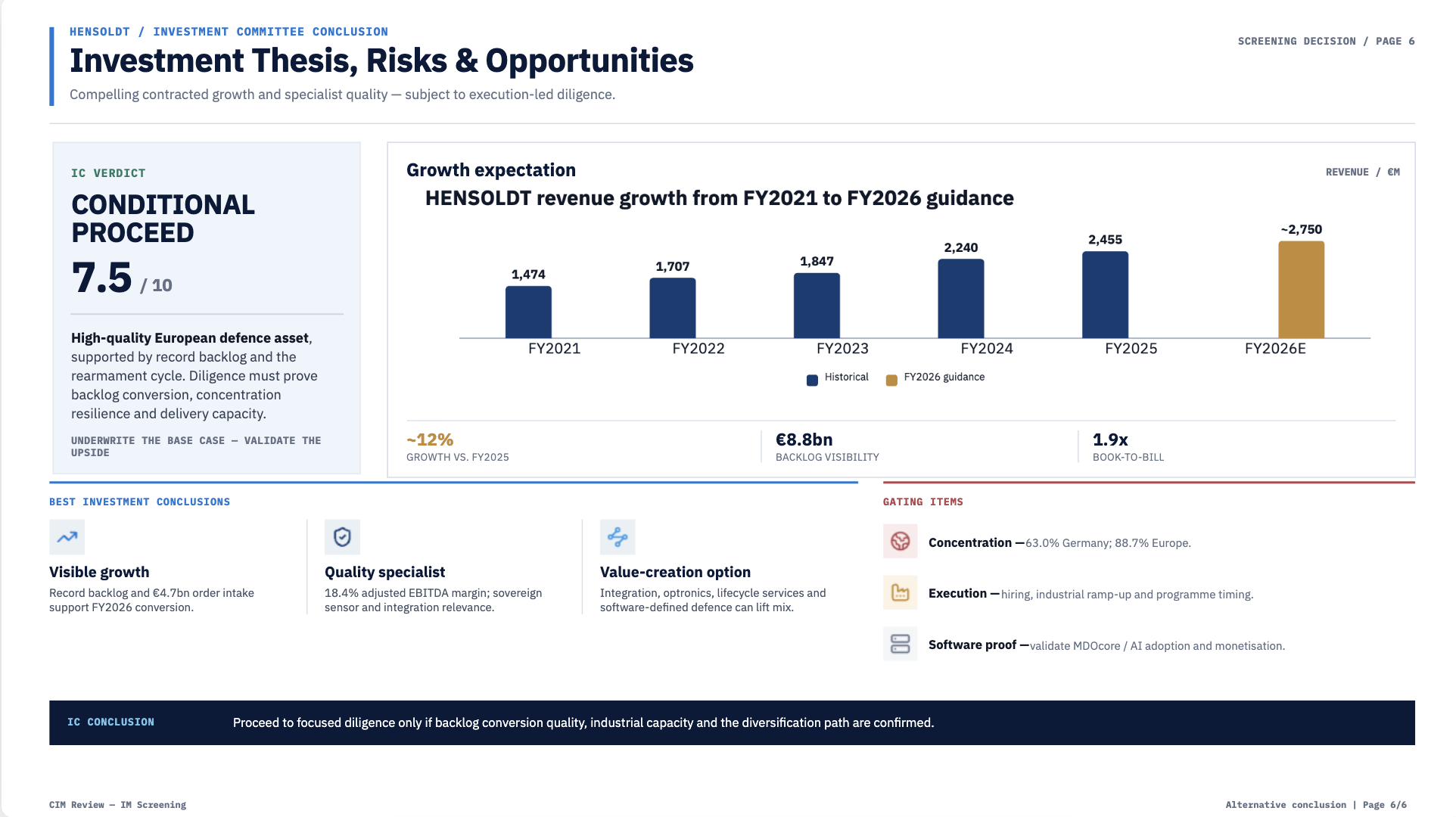
A Confidential Information Memorandum (CIM) lands in a partner's inbox at 11:42 p.m. Before anyone opens it, an AI agent retrieves the firm's history with the adviser and screens the deal against its investment thesis. If the first screen is positive, other agents analyze the CIM in depth and prepare a short set of investment committee (IC) slides for review. When the team starts work, the first-pass analysis is already prepared: they can review the evidence, challenge the recommendation, and decide whether the opportunity deserves more time.
This is exactly the kind of AI-agent system we are deploying for private equity teams. Our rule is to prioritise use cases jointly with investment and operating teams. In practice, that means interviewing users, mapping the workflow, reviewing source documents and templates, translating decision rules into agent instructions, defining approval rules, configuring a pilot, and testing the system on prior deals or reporting cycles. The aim is practical: remove repetitive work while keeping investment judgment with the people responsible for the deal.
The examples cover the PE lifecycle: sourcing, initial screening, diligence, IC preparation, portfolio monitoring, value creation, and exit planning. They show what the agent receives, what it checks, what it produces, and where a person validates the result.
We look at each system through two practical questions:
- ROI Priority: professional hours recovered, risk reduced, faster deal cycles, ability to cover more opportunities with the same team, and repeatability;
- Success Potential: a clear process owner, measurable before-and-after performance, access to the right systems such as Outlook, Gmail, Drive, SharePoint, Salesforce, Affinity, DealCloud, Capital IQ, or FactSet, clear approval rules, and consistent outputs.
1. Deal opportunity review
The challenge
Most deal opportunities arrive by email from advisers, investment bankers, or other trusted relationships. Every inbound investment opportunity consumes time before the team even knows whether it deserves deeper analysis.
The manual workflow involves several steps: open the email, create the opportunity in CRM, read the Confidential Information Memorandum (CIM), test the investment criteria, draft a note or prepare several slides for the investment committee (IC).
What we built
We built a proactive deal-review AI agent system that starts as soon as a partner receives a CIM or teaser by email for an investment opportunity —before the recipient even opens the email.
The incoming opportunity is routed to specialized AI agents with access to the relevant deal history, CRM context, prior interactions, internal ownership, and the fund’s investment criteria.
The first pass is deliberately high level (token cost optimization). An agent reviews the opportunity across the commercial, financial, operational, and market dimensions that matter to the fund, then tests the available evidence against the investment thesis.
If the deal passes the initial threshold, it moves to another AI agent that analyzes the opportunity in detail; it extracts and checks figures, flags inconsistencies, assesses fund-specific criteria, identifies risks and potential issues, drafts diligence questions, and prepares an investment committee few-pager for human review. The few-pager includes a preliminary recommendation, the points that still need confirmation, and proposed next steps.

AI agent screen
Validation gate
AI agent few-pager
The same agent can be configured and adapted by industry. In real estate, for example, a new building opportunity can trigger automatic screening, extraction of key asset and lease elements, scenario analysis, and automatic feeding of valuation and LBO models to test whether the opportunity is worth deeper work.
Impact
Measured on a review batch of 15 deals, the system made the process from CIM or teaser receipt to a first screening recommendation 70% faster. It saved three to four hours per information-memorandum triage batch.
ROI Priority: 10/10 — high frequency, expensive professional time, faster deal cycles, and greater screening capacity.
Success Potential: 9/10 — clear trigger, existing documents, standardizable outputs, and a clear review point for the team.
2. IC memo
The challenge
The IC few-pager produced during the initial review is a decision gate. Once the team decides to continue, it must turn that preliminary view into a fuller analysis for the next decision stage.
That requires deeper work on the market, competitors, financial case, portfolio synergies, value-creation plan, transformation feasibility, risks, and open diligence points.
What we built
After the team decides to continue, a dedicated AI agent coordinates specialist AI agents across the next phase of analysis. The AI agents use the CIM, financial model, internal notes, management materials, historical deals, and market intelligence data (CapitalIQ, FactSet, etc.).
They conduct detailed analysis in parallel (market, competitors, commercial positioning, risks, financial figures, etc.), test the assumptions, identify potential synergies with relevant portfolio companies, assess value-creation levers (and any proposed transformation plan), prepare an initial 100-day plan, and maintain a focused list of red flags and diligence questions.
The output is a detailed IC memo in the firm's template, with evidence and source references attached to each insight and claim so the team can review and trust the output. This follows the same auditability principle behind Lampi's granular citations.
The AI agent prepares and challenges the analysis. The investment team reviews the evidence and makes the final decision.
Multi-agent system
Impact
The system produced >75% of the IC memo draft. The remaining work stayed with the associate and investment team: verifying the evidence, polishing the argument, adding residual insights from calls or judgment, challenging the conclusions, and preparing the final committee discussion.
ROI Priority: 9/10 - meaningful time savings on a central deliverable.
Success Potential: 8.5/10 - templates and sources usually already exist
3. Technical due diligence
The challenge
The challenge of technical due diligence is to connect evidence from different sources: architecture, documentation, model and vendor dependencies, costs, intellectual-property rights, security, technical debt, roadmap, team structure, and the company’s real capacity to maintain the product after closing.
What we built
We built a multi-agent system that analyzes technical due diligence materials and returns detailed results around an Evidence / Risk / Impact / Remediation matrix.
For example, if critical product knowledge is held by only one or two engineers, the matrix records the supporting evidence, the key-person dependency risk, the impact on product maintenance or roadmap delivery, and a remediation plan such as documentation, knowledge transfer, and targeted hiring. The same structure is applied to technical debt, third-party and vendor dependencies, and questions about technical feasibility.
Specialized agents analyze architecture, data, vendors, security, and team structure separately. They then cross-check their conclusions so that a risk that looks local is not underestimated at deal level. The system produces a heat map, a management-question list, missing-evidence requests, escalation recommendations, etc.
Impact
The largest return comes from spotting material red flags early. Saving several days matters, but identifying a major issue before fully mobilizing external advisers can prevent important fees and poor capital allocation.
In one healthcare technical due diligence, the system surfaced material red flags early enough for the team to stop the planned external legal review, avoiding up to €100,000 in external fees. The team would certainly have identified the issues later, but only after spending hours connecting evidence across different sources and potentially incurring further adviser costs.
ROI Priority: 9/10 — lower frequency, but potentially very high avoided downside.
Success Potential: 7.5/10 — strongly dependent on access to evidence
4. Proactive deal-team agents for email, meetings, and CRM
The challenge
Deal teams lose time moving information between email, calendars, notes, and CRM. Important emails get buried. Meeting preparation stays manual. CRM records fall behind because updates depend on manual entry after a call or at the end of a busy week. This might be one of the most boring tasks for any associate.
What we built
This system is managed by Marc, our AI managing director, and its team.
The inbox agent runs on each relevant deal or portfolio email. It identifies the company and process, links the message to the correct deal or portfolio record, and retrieves the latest context. It drafts a reply, applies labels, extracts actions, deadlines, and owners, and flags any item that needs human attention. No external reply is sent without the required approval.
The meeting briefing agent runs before each relevant calendar event. It uses CRM records, prior emails, meeting notes, documents, relationship history, open questions, and the latest deal or portfolio context. The brief covers attendees, objectives, unresolved points, likely questions, and recommended next steps.
The CRM update agent watches approved deal sources such as email, calendar events, meeting transcripts, Drive folders, and CRM records, then detects the links between people, companies, relationships, opportunities, deals, and activities. When a new PE opportunity appears in an email or meeting note, it can propose a CRM update with the company, process type, people involved, source evidence, and confidence level.
It also detects the signals that usually fall through the cracks: a follow-up promised but not sent, a deal with no activity for too long, an NDA sent without a response, or a diligence process where document activity has stalled. Marc turns those signals into daily suggestions: which follow-ups to send, which stalled deals need attention, which dormant relationships to reactivate, and which material pipeline changes the team should review.
The CRM stays current with less manual entry, while higher-risk changes still require team approval. Marc keeps track of promised follow-ups, stalled deals, unanswered NDAs, and dormant relationships so the team does not lose sight of the next action.
Impact
The agents recover time throughout the week rather than in one large batch. Records are cleaner. Fewer follow-ups are missed. Meeting preparation is more consistent, and the next person who opens a deal record can understand it quickly.
ROI Priority: 10/10 - recurring time savings across the full team, with fewer missed actions and better use of CRM data.
Success Potential: 10/10 - strong when email, calendar, and CRM permissions are clear and each automated update has an appropriate review rule.
5. Portfolio monitoring and AI-led value creation
The challenge
Portfolio teams spend significant time collecting and consolidating monthly and quarterly reporting from portfolio companies, reviewing actuals against budget and forecast, investigating variances, and preparing questions for management. Across a 20-company portfolio, the same exercise can recur 20 times.
Monitoring is only one part of the problem. After close, the investment and operating teams must turn the value-creation case into a practical 100-day plan. Today, they also need to identify where AI can improve revenue or cost inside the portfolio company.
What we built
Portfolio reporting
Each month or quarter, the portfolio company sends its reporting pack to the investment or portfolio team. That pack is forwarded to a monitoring agent that does the first pass an associate would normally do: extract the key figures, check them against the prior period, budget, and forecast, reconcile figures across the pack, identify caveats, detect missing data or unusual movements, and track covenant headroom where relevant.
The agent then prepares the practical follow-up work: a list of questions for management, items that require review, explanations for material variances, and a draft update if the company should be included in the next investment committee or portfolio review report. The team reviews and adjusts the output before it is used externally or circulated internally.
AI-led value creation
For portfolio value creation (pilot stage in progress), a separate AI workflow assessment agent connects to the portfolio company's approved data systems and reviews the evidence available across tools, files, emails, drives, and meeting transcripts where relevant. The goal is to identify recurring tasks and functions where AI could improve workflows, including customer-support triage, sales follow-up, invoice matching, procurement quote comparison, churn-risk monitoring, and less visible operational work inside finance or reporting.
For example, an invoice-matching opportunity is assessed against invoice volume, access to purchase-order and receipt data, current exception rates, and the approval rules required before anything reaches the ERP. This turns a broad idea into a workflow with a baseline, required data, owner, validation step, and measurable result.
The result is an AI opportunity review of the portfolio company: where work is repetitive, where data is already available, where handoffs create delays, where controls or reviews are needed, and where an AI agent could realistically be deployed. The output is a ranked set of workflow opportunities based on the company's real tools, data, and workflows.
Each opportunity is ranked by expected value, feasibility, data readiness, and accountable owner. The system records the baseline, required integrations, validation method, dependencies, and first deployment step. The operating team can then select the highest-priority cases and deploy dedicated agents with clear human approval points.
Impact
The reporting system saved 15 hours per portfolio company per reporting cycle by reducing the work required to collect packs, consolidate figures, check actuals against budget and forecast, investigate variances, track covenant items, prepare management questions, and draft the portfolio update. Across a 20-company portfolio on a quarterly cadence, that represents 1,200 hours recovered per year.
The same source base also supports earlier action. Teams can identify a covenant issue sooner, prepare the right management questions, and move from a broad AI discussion to a ranked list of deployable use cases. This gives the 100-day plan clear owners and measurable next steps.
ROI Priority: 9/10 - high repeatability, substantial annual volume, and a direct link to portfolio performance.
Success Potential: 9/10 - clear cadence and identifiable owners; data normalization and management adoption remain the main constraints.
6. Buy-and-build target ranking and exit buyer shortlists
The challenge
A PE firm or one of its platform companies may be looking for acquisition targets to support a PortCo's growth, or preparing an exit and searching for the right universe of potential buyers. This work can be performed internally or externalized to advisers, but the core problem is the same: the team needs to move from a broad market universe to a focused list of companies worth pursuing.
Today, it is relatively easy to identify private or public companies using market-intelligence tools and database filters such as sector, size, revenue, geography, or ownership. What is harder is reviewing the relevant signals for hundreds of companies at once — recent activity, ownership clues, strategic fit, relationship context, deal-readiness, and possible synergies — then matching each target or buyer against the portfolio company, the investment thesis, and the strategic rationale.
What we built
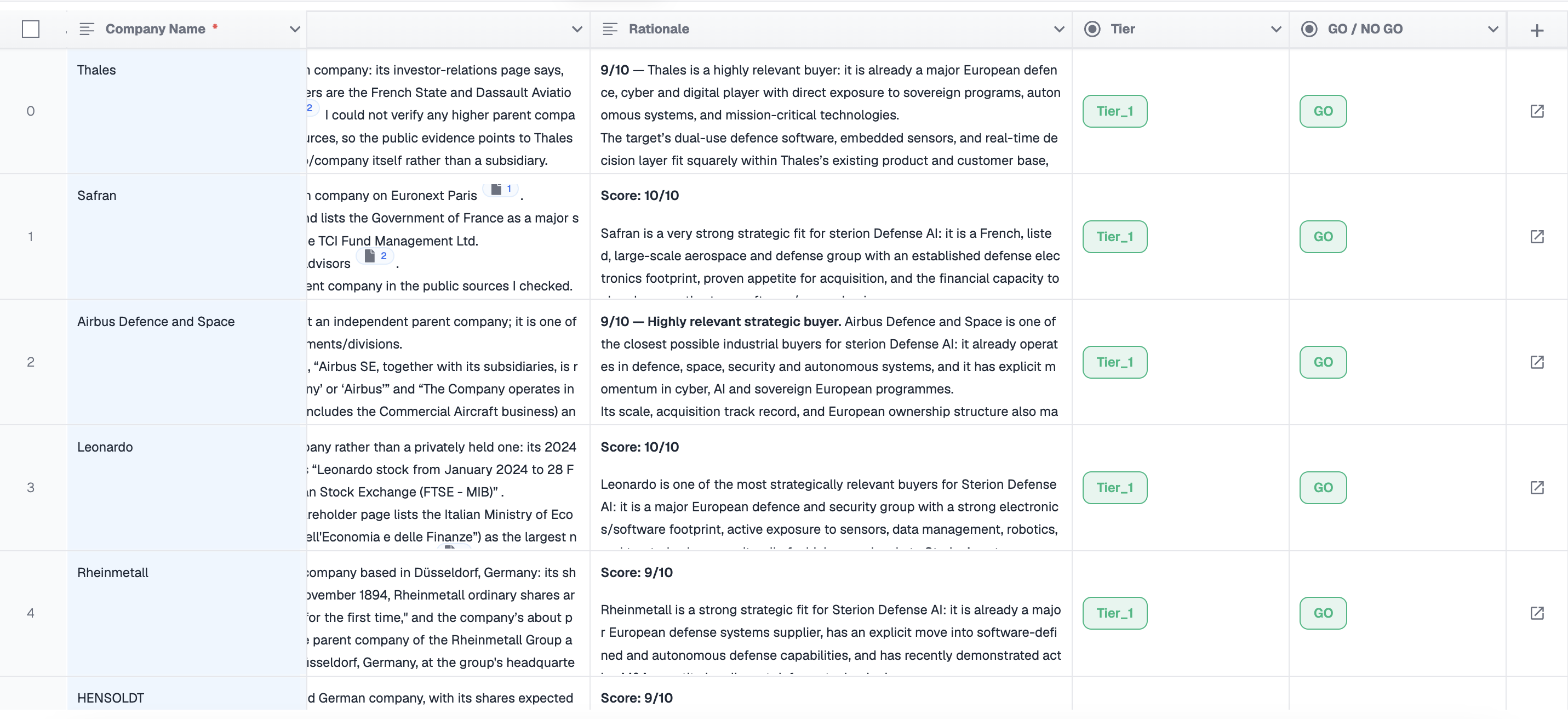
The AI Grid agent allows hundreds of agents to run in parallel while applying the same workflow and scoring rules consistently. The Grid is organized around the work itself: each column represents a workflow step with specific instructions, each row represents a company, and each cell is an AI agent completing that step for that company.
For a screening exercise, the team can import a list of companies from a third-party market-intelligence platform. Across the full list, the agents search for the signals defined by the team, use the context of the PortCo or deal, assess strategic fit and potential synergies, and record the rationale and supporting evidence. A 500-company input can therefore produce a scored top-50 shortlist for the investment team to review.
For buy-and-build, the Grid can rank add-on targets against the PortCo's growth priorities, including commercial adjacency, geography, customer overlap, product complementarity, operational synergies, and deal-readiness signals. For exit preparation, it can rank corporate and financial buyers using acquisition history, strategic rationale, financial capacity, relationship strength, and fit with the asset.
Import
Run the AI Grid
Review
Each agent can also prepare a short personalized outreach or pitch angle for the highest-priority companies, which is particularly useful when the workflow supports M&A origination or buyer outreach.
Impact
The agent expands the number of companies the team can review and returns a prioritized shortlist. Deal professionals start with ranked targets, clear rationales, and the evidence needed for the next research step.
ROI Priority: 8.5/10 - broader coverage and more focused origination effort, with no proportional increase in headcount.
Success Potential: 8/10 - explicit scoring rules are essential.
The six workflows above cover deal intake, IC preparation, technical diligence, CRM, portfolio work, sourcing, and exit preparation. PE teams can apply the same approach to other recurring work, including LP reporting automation, personalized fundraising deck preparation, debt covenant monitoring and breach alerts, NDA review and red-flag detection, and expert call note synthesis.
How to choose the first AI agent use case
The best first use case combines sufficient volume, visible pain, available data, a motivated owner, and an output that is easy to review.
In many PE firms, initial deal review, IC-memo generation, or portfolio reporting is a better entry point than a broad platform deployment. The before-and-after is easier to observe: time to first draft, number of documents covered, error-detection rate, validation time, and senior capacity reallocated to higher-value work.
A practical prioritization exercise should include both economics and operating readiness. Estimate the current cost of the process, including review and rework rather than only the initial analyst hours. Then test whether the required sources are accessible, the output has a stable structure, and one accountable professional can audit it. A high-value use case with no owner or reliable source base may be a worse first deployment than a narrower process with clear evidence and repeatable review.
What turns a prototype into a production system
A prototype proves that a model can complete one example. A production system must deliver reliable, repeatable work despite imperfect documents, exceptions, permission constraints, and real-world consequences.
- A clear process owner. This person defines the standard, escalation rules, and approval process. Without ownership, errors never become process improvements.
- A measurable before-and-after. Documenting the trigger, steps, contributors, time, rework, and final deliverable makes it possible to measure turnaround time, coverage, consistency, adoption, and recovered senior capacity.
- Existing source material/templates. The best systems start with sources that the team already uses: CIMs, VDRs, CRM records, Excel models, IC memos, contracts, or reporting packs. AI cannot sustainably compensate for missing data.
- Simple human validation. The reviewer must be able to audit and approve the output. An opaque output relocates the work instead of reducing it.
- Repeatable outputs. Whether the deliverable is a scorecard, issue list, covenant table, Excel model, few-pager, or deck, the schema, mandatory fields, and formatting rules must remain consistent.
- A significant pain point. Deal flow, IC deadlines, data-room volume, and quarterly reporting create enough day-to-day pressure for teams to adopt a new workflow.
- Auditability and fact-checking. Every material number, clause, or conclusion should retain enough source context — document, page, period, and calculation method where relevant — so the team can audit and fact-check the AI output.
- Continuous evaluation. Tests should cover numerical precision, periods, units, definitions, contradictions, rare clauses, missing documents, and unsupported statements. Every material system change should be evaluated before reaching a live process.
Conclusion: Start with a private equity process worth delegating
Start with a recurring process that consumes expensive professional time. Connect the sources the team already uses. Define the output and review standard, then measure the result. The agents handle the repeatable analysis and production work. Investment professionals review the evidence, challenge the conclusions, and make the decision.
Lampi builds auditable agent systems around the workflows that already drive sourcing, screening, diligence, committee preparation, portfolio work, and exit planning.
Want to test this approach on your deal flow, diligence process, IC packs, or portfolio reporting? Request a tailored demo built around a real process from your team.